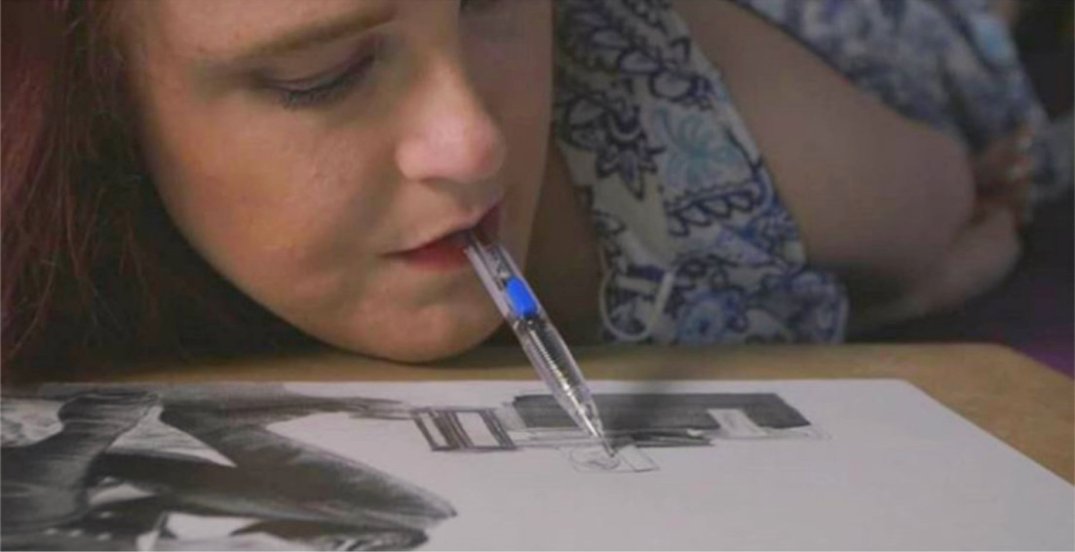
Good grief! What a ride it’s been since I last blogged about what I’m now calling The Chamberlain Project. I need everybody to go read the first blog before you continue with this one because it lays out all of the information about why we’re here and why the Joshua Lawrence Chamberlain house is an important American landmark that needs our help. It has been one of the most fulfilling and challenging things I’ve done as an artist.
Briefly, Joshua Lawrence Chamberlain was a Union general in the American Civil War who rose to that rank without formal military training (he was a professor before the war). He volunteered for service, and then later became a four-term governor of Maine, followed by president of Bowdoin College. National history largely forgot Chamberlain until Ken Burns heavily featured him throughout his documentary series, The Civil War. Then in the early 90s, Jeff Daniels played Chamberlain in the film, Gettysburg, followed ten years later by playing him again in Gods and Generals.
Together, you and I are helping the Pejepscot History Center preserve and restore his home, which is now a museum.
CBS Evening News
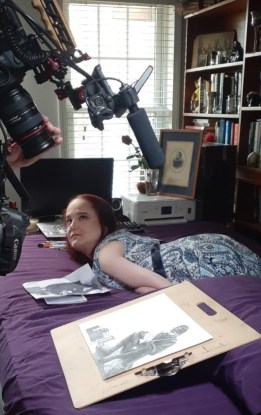
The wildest part of this whole thing is that the CBS Evening News did a feature on me a couple of months ago outlining my project and the Pejepscot History Center’s involvement in it. When I got the initial call from the producer in New York City, I actually thought it was a prank and I almost deleted the message!
CBS sent a crew to my home a few weeks later after some scheduling conflicts. Who would have thought the New Hampshire primary was a bigger story than trying to preserve and restore an American landmark? Said with humor. It worked out better having the scheduling conflict because it gave me time to get a head start on my second Chamberlain-related project, which we’ll discuss further down in this blog. You can see a photo from the shoot I did with CBS that day on the right. They were getting what’s known as B-roll of the new piece of art. B-roll is what you see on film while a journalist or narrator is talking over it.
I think I did all right. They shot about 45 minutes of footage for a 2-minute story at the end of the nightly broadcast. To be honest, I could do an entire hour-long show about how exciting and important historical preservation is, and the crew even mentioned how knowledgeable I was about the field. Clearly, I missed my calling. I should have gone to college to get into historical preservation.
Here’s my segment on the CBS Evening News.
The Numbers

After my segment aired that night, I got a lot of new orders for not only the Chamberlain house drawing but everything else in my Etsy shop too. I got more than I expected and it was, quite honestly, more than I could handle by myself, so it has taken a while to get all of the orders shipped. I’m down to my last dozen or so right now, which will go out in the mail as soon as my latest restock batch arrives. This process has been difficult because I don’t have the money to get my own printer capable of doing 11×17-inch prints. I have to outsource the printing process.
I promised you all that I would be up front about the earnings and donations numbers. If you want more specific information, you can always pop me a message and ask.
We have raised $1,800 so far, which is being given to the Pejepscot History Center in three separate payments. I only expected to raise a couple hundred bucks in the beginning, so this number pleases me. People still buy the art print without me doing much advertising now that it shows up in Etsy searches and such.
The PHC has been incredibly grateful for our work!
The New Project
Right before CBS came to film my segment, I began putting together my second project. I’ve been in this art business long enough to know that sales will eventually taper off and you need fresh things to keep customers interested. I knew I was going to divide The Chamberlain Project into three distinct art pieces so I could keep providing the PHC with donations throughout the year of 2020.

The first thing I needed was a photo reference that I found inspirational for the story I wanted to tell in Joshua Lawrence Chamberlain’s wartime career. Enter my friend, Guy Gane, who is an actor, casting director, and tailor. He agreed to let me use him for reference (any artist who says they can work on highly detailed portraits without some kind of reference is either a liar or inhuman) since he has the same body type and similar features as Chamberlain, especially in the hands. Since Chamberlain was about four inches shorter than Guy, I chose a photo that would conceal the height difference rather than accentuate it. The photo on the left was the one I chose.
Next, I needed to mentally put this modern candid photo in a wartime context. What would Chamberlain be holding instead of a cell phone? Either dispatches, orders from his superiors, or a letter. What’s more emotionally compelling to the viewer? Letters from home, clearly. Everyone who has heard of Chamberlain knows something of the bond he had with his family.
I created a story around this piece of art from there, knowing I wanted to steer clear of Gettysburg because that topic has been done to death.

In the last weeks of the Civil War, Chamberlain was a brigade commander in the Battle of Quaker Road on March 29, 1865. That day, he had been ordered to take the Confederate position and led his men on horseback until he was wounded in the arm after his horse had been shot through the neck. He was briefly knocked unconscious and witnesses thought him killed.
Riding ahead until the wounded horse couldn’t continue, Chamberlain dismounted and continued on foot until he got so far ahead of his men that he ended up alone, surrounded by Confederate soldiers. Quick thinking, a faded, filthy uniform, and a knack for mimicking accents convinced the Confederate soldiers that he was one of them until he managed to get out of the dangerous situation – all while suffering with a wounded, bleeding arm.

My drawing imagines a quiet moment of contemplation the night after that close call. Chamberlain is depicted thoughtfully reading a letter from home and is surrounded by his books and a photograph of his wife, Fanny. Now that the danger has passed, he has time to think about what he could have lost if yet another close call had ended him after all. It’s a hint at the post-traumatic stress disorder to come, which is something not a lot of people talk about in terms of their heroes.
It was not easy completing this piece, on a personal note. One of my dogs was diagnosed with congestive heart failure and she died within two weeks of the diagnosis. Then my other dog broke her foot and the subsequent bone infection resulted in one of her toes being amputated, a procedure from which she is still recovering. COVID-19 messed with our household income and now the virus has spread to more than one house on my street. Given my weakened immune system, contracting the virus could be deadly for me, not to mention the surgery I was supposed to have on April 16 being pushed back to sometime this summer. I’ve also been nursing a broken heart.
Yet, I managed to finish this piece even with all of the terrible things happening around me. I suspect things in my personal life did, in fact, draw me closer to the mood of this piece. Maybe it helped me make it better. I need to believe I channeled my pain into something bigger than myself. That’s the artist in me.
In the end, this is how the second piece turned out.
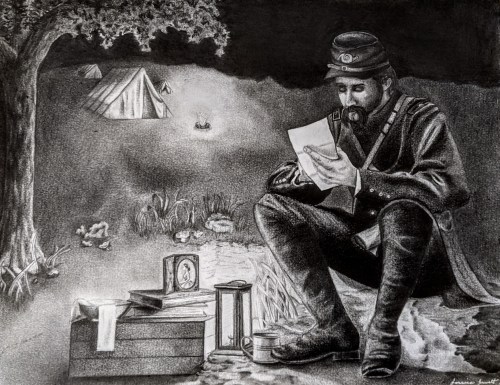
I, personally, like how it looks but there are always things I would change about every piece of art I do. It was done in a combination of Pentel mechanical pencils with .5 mm lead and Prismacolor Ebony pencils on mixed media paper. You’ll be able to buy various sized prints of the original art over on my Etsy shop. The original is 11×14 inches and has already been sold. Prints (5×7, 8×10, or 11×17 inches) range in price from $13.80 USD to $27.60 USD and are made on high quality cardstock with a glossy finish. Original art prices are calculated based on the materials used plus a $15 hourly labor rate, which is quite low for many artists.
Let’s not forget why we are here.
A portion (75%) of the sale of this drawing benefits the Pejepscot History Center in their efforts to preserve and restore the Joshua L. Chamberlain house for generations to come. The porches that Chamberlain himself built on his home of over fifty years are in structural danger due to wood rot and lack of maintenance over the last century. Together, you and I are going to help with the restoration costs. Buildings like this one belong to all of us.
What’s Next

There will be a third piece (technically fourth if you count the church) to finish out the year and hopefully generate more donation revenue. I knew from the beginning that I wanted to do something involving Fanny Chamberlain because, most of the time, she is reduced to a footnote in her husband’s history. She was a deeply complicated woman in her own right with passions, interests, beliefs, and dreams of her own long before she was ever a married woman.
My plan is to do something revolving around Fanny Chamberlain, possibly in the downstairs blue parlor, which the family had built after the Civil War. I suspect I’ll have her playing the piano but I’m not quite sure yet. It depends on where my inspiration leads like it did when I chose Guy Gane to model Chamberlain for me.
How To Order
These are the links to order all pieces I’ve done relating to Maine. I had done the church a long time ago before all of this started but I figure it can be included here as well.
First Parish Congregationalist Church – BUY HERE
Joshua L. Chamberlain House – BUY HERE
After the Battle – BUY HERE
Please consider purchasing these art prints. It’s such a worthy cause. I realize there is a lot happening in the world, and I’m doing my part for those causes as well, but we should care about American history too. We need to be thinking about what kind of tangible legacy we’re going to leave our children and grandchildren. Wouldn’t you want to teach your descendants to celebrate and honor a man who believed in the qualities of a better world that we’re still fighting to create? What better way to honor him and his family than to help preserve the place they loved and called home for over half a century?
If you’re not interested in buying my art, that’s quite all right. There are choices.
One option is to let me collect the donations at PayPal.me/ArtByJessicaJewett and I’ll get it to the Pejepscot History Center for you. Please specify that you are donating to the Chamberlain house in the notes. I’ll send donations on the 15th of every month (when there are any) and I will give you copies of the receipts.
Or you can make a donation directly to the Pejepscot History Center, but please make sure you specify that your donation is for the Chamberlain house. They don’t have digital donations aside from the annual membership drives. The new 2020 membership drive hasn’t been created yet since they are closed until February 4.
To donate by mail:
Pejepscot History Center
159 Park Row
Brunswick, ME 04011
By phone: Call (207) 729-6606 to provide a credit card number. They take all major cards.
In person: Drop by their offices at 159 Park Row during open hours.
Once again, I thank all of you for joining me on The Chamberlain Project’s journey!
The Pejepscot History Center is a non-profit, tax-exempt 501(c)(3) organization. Your gift is tax deductible to the full extent allowed by law.
I’m not affiliated with the Pejepscot History Center in any way, nor do I work for them. My fundraising efforts are as a private citizen.

Donation
Please consider making a donation to help me keep up with the cost of art supplies, living expenses, equipment related to my disability, and so forth. The minimum is set at $10.00. Thank you for your generosity.
$10.00
Follow me on social media!





 Short story (although I beg you to read the entire blog): I’m selling a drawing of the Joshua Lawrence Chamberlain house and donating the profits to preservation and restoration efforts.
 National history largely forgot Chamberlain until Ken Burns heavily featured him throughout his documentary series, The Civil War. Then in the early 90s, Jeff Daniels actually played Chamberlain (seen in character on the left) in the film, Gettysburg, followed ten years later by playing him again in Gods and Generals.
 Why does the decay of an old house matter to me?


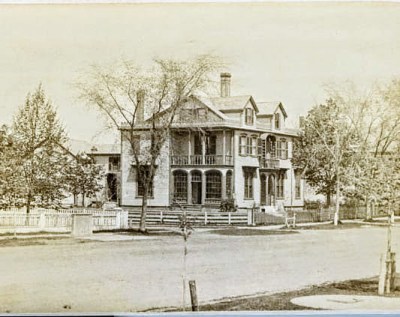
 So I decided to make donations interesting. Individually, none of us can afford the $20,000 the PHC needs to raise to save Chamberlain’s porches from decaying and deteriorating. I know I can’t.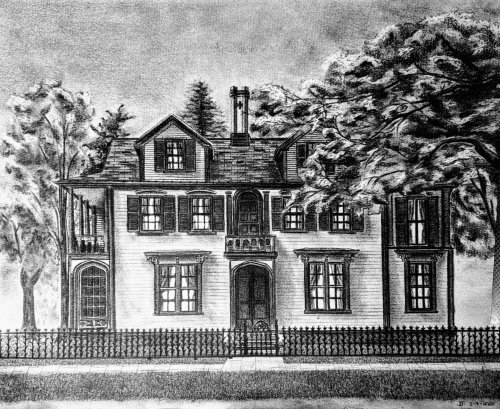
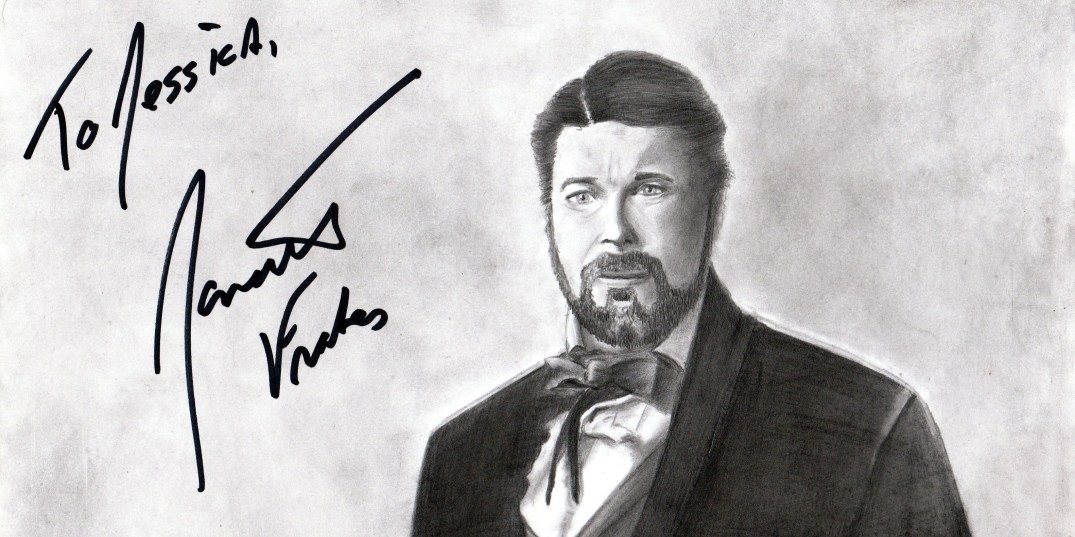
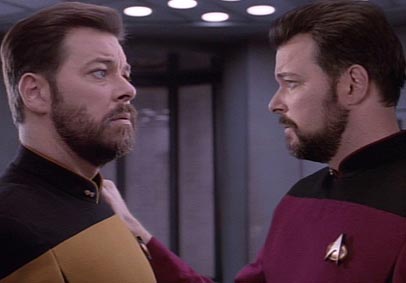
 We have to start way back in 1987 when the Civil War led me to the Final Frontier. I watched the second part of a huge miniseries called North and South that actually began in 1985, but I don’t remember seeing it then. I was pretty young and going through some rough things in my family. The important thing is North & South had a character called Stanley Hazard played by (drum roll, please) Jonathan Frakes, seen here in Book III in 1994. At the same time that he was making Book I and II of North & South, he was also starting to work on Star Trek: The Next Generation. Presto! I followed “the guy with the blue eyes and the chin dimple” (quickly covered by a Civil War-appropriate beard) from the 19th century to the 24th century when I wasn’t interested in sci-fi at the time.


 Yet I did see Jonathan every day on the ship. Most of the time he saw me too, but there were a few times when he was engrossed in talking to other people or headed somewhere fast (someone with legs that long moves much faster than I do) and I just didn’t want to be a bother. I ran into him immediately on my way to breakfast on the first day at sea. A big smile came over him and he rubbed my arm and spoke familiar greetings. I hadn’t had my coffee yet but that was a better wake up than caffeine. If you’ve ever been the target of his real smile, you know what I mean. I couldn’t believe it seemed like he remembered me.
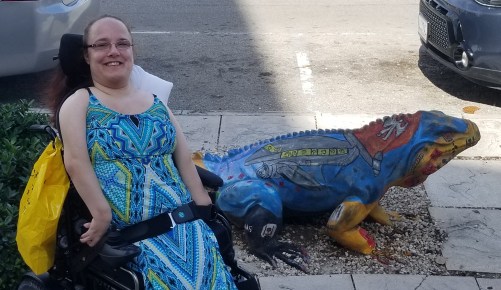
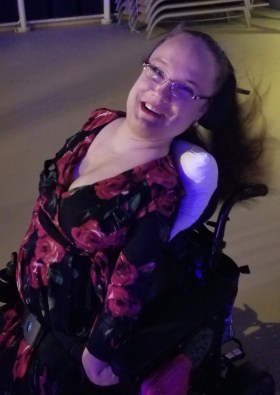 Apparently one night while I was trying to find Jonathan’s photo op line, Jason Isaacs very nearly bumped into me and said hello but I never noticed him. So naturally my brother, who loves Jason Isaacs, made fun of me for the rest of the night and swore he was going to tell Jonathan that I was so laser focused on him that I completely missed Jason right in front of me. He never ratted me out. I think he values his life too much. But he might have had a point. Let’s be real. I spent a lot of time looking for a dress that made me feel like a lady to wear in my photo op. I didn’t say that, of course, but I was hoping Jonathan would notice it. He has to be a mind reader or he sincerely meant it because he said, “Beautiful dress,” without being prompted. The photo here is me strolling the pool deck after seeing him. I look drunk. I swear I wasn’t. I rarely get compliments from men that aren’t followed up by unsolicited photos of nude genitalia or being propositioned to send my own nude photos, so it was a moment.


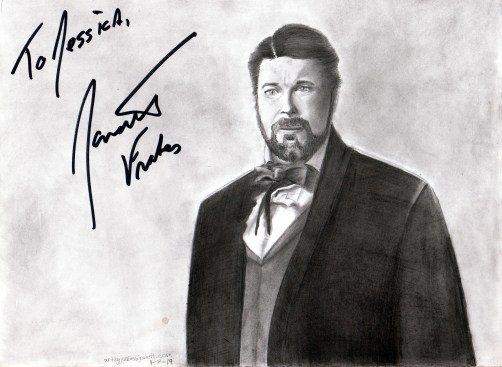

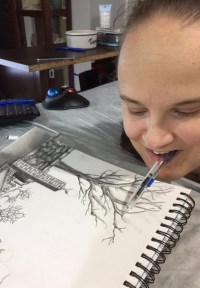 I have been a portrait artist for so long that I almost got to a point of never imagining myself doing anything else. That’s not necessarily a good thing, however. Artists, in my opinion, should definitely develop a style but not at the expense of challenging themselves. There comes a point when you’re doing the same thing again and again that your creativity goes flat, so it’s incredibly important to find ways to stretch your style into new subjects.
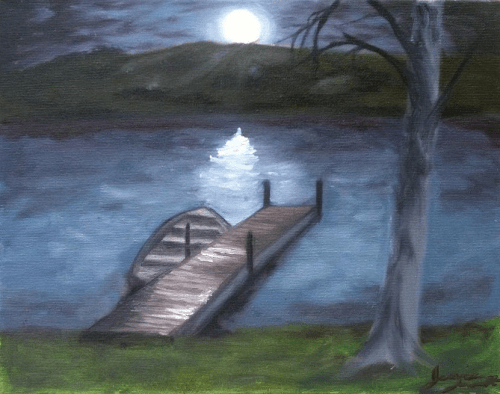




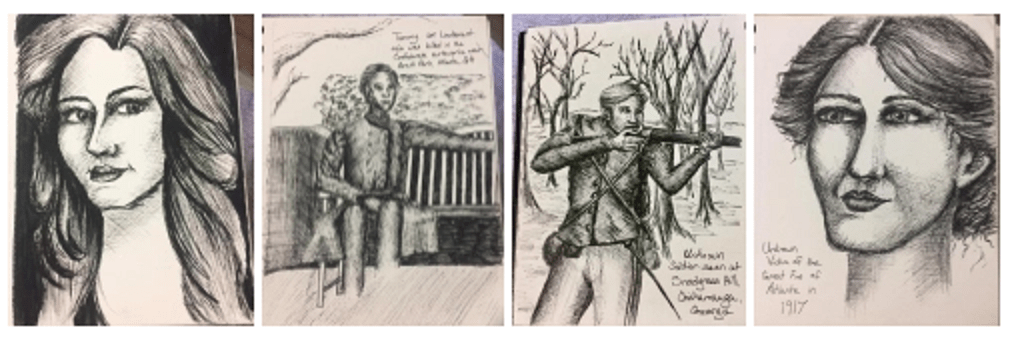
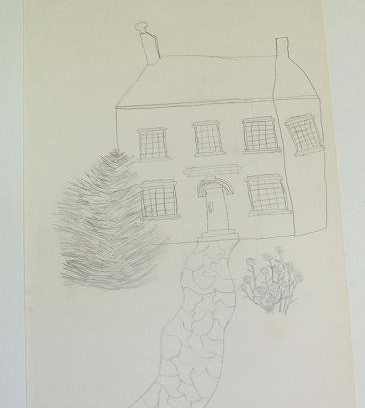
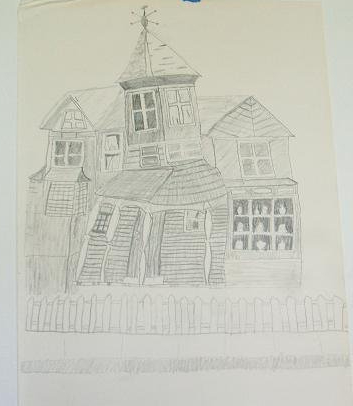
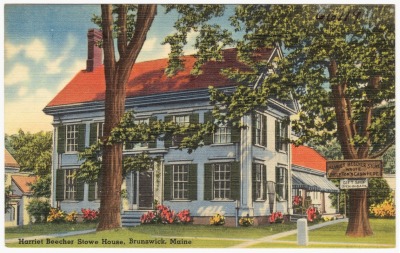
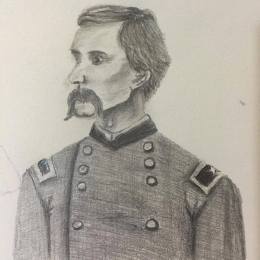 Many of the drawings I made in my childhood were of these two people over and over again in different poses and doing different things. Since I threw away most of my old sketchbooks out of fear of being judged or questioned, I only have these examples to show that were done several years ago. They are Fanny and Joshua Lawrence Chamberlain, who were deeply connected to the house drawings from earlier in my childhood (seen above). The Chamberlains were from Maine and lived through the bulk of the 19th century. Lawrence was a college professor who volunteered for the Union Army in the American Civil War, eventually rising to the rank of Brevet Major General. After the war, he became Governor of Maine. His wife was a music teacher and artist trained by highly respected creative minds of their period.
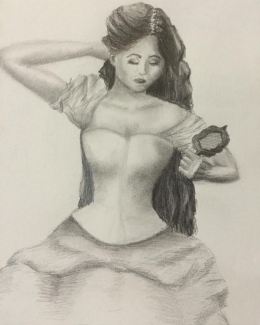 In 1999, I realized through events too numerous to list here that I was Fanny Chamberlain in a previous life and my obsessive need to keep drawing these people was my subconscious mind trying to say it out loud. Specifically from ages six to nine, I filled page after page of drawing paper depicting mostly Fanny and Lawrence but also many other members of their families. I had no idea who they were until the summer between my junior and senior years of high school but their lives replayed in snippets of my memory. Drawing their faces soothed me a little bit, especially when I was plagued by nightmares of Civil War military hospitals. And that was what I was really after in my mind – soothing the unexplained images by dumping them onto paper. If this story interests you, go take a look at the book I wrote about it called
 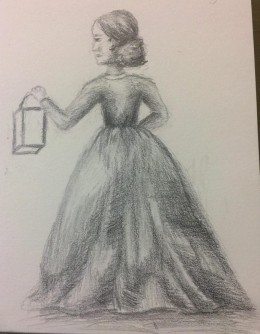 Here is another drawing of Fanny surviving from a much earlier period in my life (right). The best way for me to date my drawings is to place them before or after the bulk of my real technical training in the late 90s. I believe I did it somewhere between 1995 and 1997 before I knew who Fanny was, and then I fiddled with the skirt again many years later after I learned more about drawing fabric. This sketch is incomplete to this day.


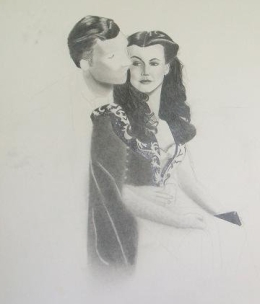 By mid-2000, I had developed much stronger technical skills and embarked on a large, highly detailed piece from Gone With the Wind. It was my effort at keeping myself occupied through the summer to stay “normal”. Once I realized a few years before that I was seeing the dead, I wanted nothing to do with it. I was a teenager desperately trying to fit in as all teenagers do.
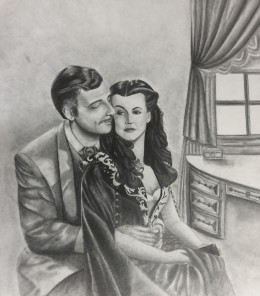 It took 16 years and surgery on my eyes to pick it up again, seen here.
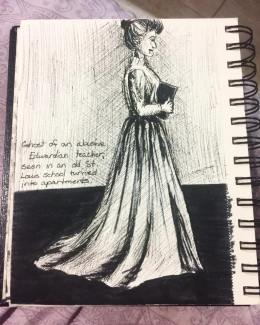 Last year I did several new sketches of the dead I’ve met. I thought back to the one who frightened me the most when I was about 8-years-old and I committed the experience to my sketchbook (seen on the right). My uncle and aunt shared an apartment in St. Louis when I was little that used to be a school at the end of the nineteenth century into the early twentieth century. That building was always uncomfortable – something my mother and I never discussed until I was an adult. She never saw the teacher but I did and feeling such negativity from a spirit that abused children in life frightened me into silence for years afterward. Mom knew I was telling the truth because she had the same sensations at the time as well. The teacher was not at rest, probably because she died believing she would be judged for her deeds in life and refused to move on, instead getting stuck in the building where those deeds happened.


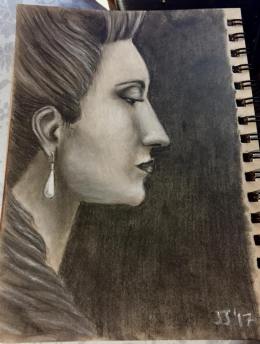 I’ve come full circle in a lot of ways with this spirit art. It began with drawing my past life memories, drifted into drawing the dead around my city, and now I’ve allowed myself to memorialize another past life of mine. Drawing allows my mind to go silent and I meditate on every little line. And when I need to release something to the universe, sometimes drawing it in great detail facilitates that liberation for me.
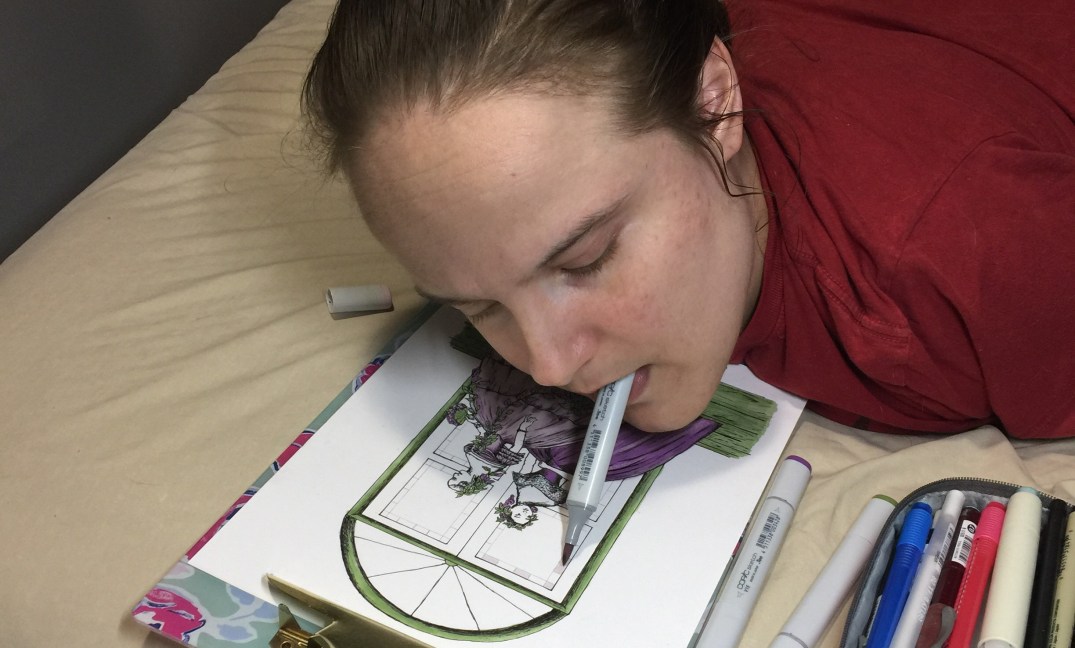
 It was a total impulse buy a few months ago and here we are now. My honest confession is that I can’t stop using these pens. They live on my desk on a permanent basis. I’m regretting the fact that I only got the 24 set considering there is the glorious bounty of a 72 set too.
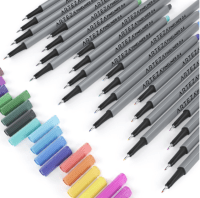
 Here are some of my experiments with the Arteza Fineliners.


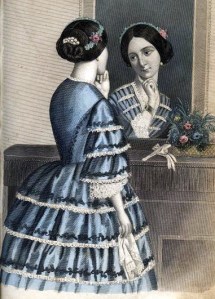
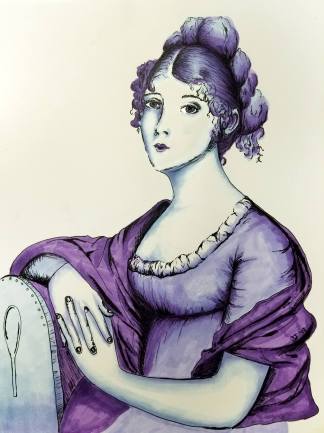 I found the inspiration for Miss January in a portrait from 1803 of a woman who actually lived at that time. I made her into a fashion plate instead of a painting, which created a new and different woman altogether. This was my first fashion plate illustration and I feel like I made some mistakes since I had no real experience before with this style. I’m honestly making it up as I go, which means I ought to be more forgiving of myself, but I’m very critical. I see lots of things that should have been done differently. Still, people seem to like it!
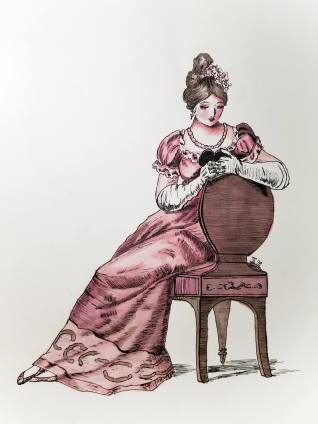 I’m personally very enamored of this one. I got the inspiration for Miss February from an illustration that was dated 1815, although I don’t know if it was an actual fashion plate or not. Sometimes artists just used the popular style of the period when they were doing pen and ink work. I think the original version was yellow but I might be mistaken.
 I’d say this one has been the hardest for me to do so far. It was probably the plaid fabric that made me struggle as much as I did. I had trouble seeing where the natural skirt folds should be vs where the plaid pattern went. Green is a tough color for me to see for some reason. Multiple shades of green tend to blend into one bright shade if I’m not completely and utterly focused. I think I did fairly well, however.
 Art By Jessica Jewett